How do you track possible migraine triggers?
Record each attack consistently, add possible triggers and relevant context, and review multiple episodes for repeated associations. Treat the result as a hypothesis. A diary can show that two things occurred together; it cannot prove that one caused the other.
Migraine attacks can happen in a complicated mix of sleep, stress, meals, hormones, sensory exposure, weather, medicines, and other circumstances. The Mayo Clinic describes many commonly reported triggers, but your own record can be more useful for discussing which patterns may apply to you than assuming every item on a generic list does.
A five-step trigger-tracking method
1. Record the attack before interpreting it
Start with the time, duration, severity, symptoms, and impact. This creates a stable episode record before a possible explanation changes how you remember the event.
2. Capture nearby context
Note changes that stood out before or during the episode: disrupted sleep, unusual stress, skipped meals, certain foods, travel, bright light, strong smells, temperature, humidity, or pressure changes. Use your own language and keep the list manageable.
3. Include treatment timing
A treatment can change the shape or duration of an attack. Record when you used a medicine or remedy and what happened next so treatment response is not mistaken for a trigger pattern.
4. Review across many episodes
One coincidence is not a pattern. Look for the same factor appearing repeatedly, whether it is also present on days without migraine, and whether several factors tend to overlap. Migraine threshold may be influenced by a combination of circumstances rather than a single cause.
5. Discuss the hypothesis
Bring the pattern and the underlying entries to a healthcare professional. Ask whether the association is meaningful and whether any change is safe. Avoid eliminating large groups of foods, changing medicines, or making other substantial health decisions from an app pattern alone.
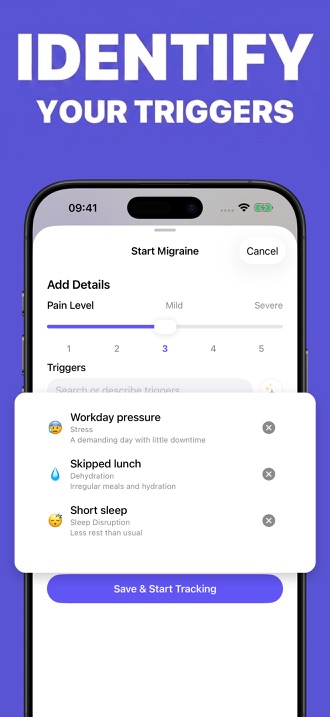
Type or dictate what happened in your own words. Auralog can surface possible personal triggers from the note, reuse triggers you have already saved, and keep them beside symptoms, treatments, and severity. Auralog 27 also adds optional weather and recent-sleep context.
Track with AuralogFour mistakes to avoid
- Tracking everything at once. Too many fields can make the diary difficult to maintain. Start with what is most relevant.
- Confirming the first suspicion. Continue recording information that does not fit your theory.
- Ignoring baseline days. A suspected factor may be common even when you do not have a migraine.
- Changing several things at once. If sleep, food, routine, and treatment all change together, the next record will be harder to compare.
Questions a useful history can answer
A well-kept migraine trigger diary can help you ask: Does poor sleep often appear before my attacks? Are several factors present together? Do attacks cluster during certain weather conditions? Does a treatment seem more useful when taken earlier? Are my symptoms or frequency changing?
These structured observations give you and your clinician a history you can inspect.
Sources and further reading
- Mayo Clinic: Migraine symptoms, causes, and commonly reported triggers
- National Headache Foundation: Tracking Diaries
Sources were checked August 9, 2026. See our editorial policy for how Auralog guides are written and updated.