Can barometric pressure be linked to migraine?
Weather and barometric-pressure changes appear to affect some people with migraine, but sensitivity varies and attacks may involve several overlapping factors. Track precise attack timing beside local conditions over multiple episodes and discuss any repeated pattern with a healthcare professional.
The Mayo Clinic lists barometric-pressure changes, high humidity, heat or cold, wind, storms, glare, and dry air among weather-related factors reported by some people with migraine. It also recommends a headache diary as one way to investigate whether you have specific weather-related patterns.
A 2025 systematic review of barometric pressure and migraine found inconsistent results across studies: some reported associations with attack frequency, evidence about severity was unclear, and the overall evidence was limited by varied methods and potential bias.
What to record when tracking weather and migraine
Attack start and end
Weather can change quickly, so a precise start time is more useful than a note that simply says “stormy day.” Record when symptoms began and when the episode ended.
Barometric pressure and direction of change
A single pressure reading gives limited context. If your tracker supports it, note whether pressure was rising, falling, or relatively stable around the episode. Do not assume a particular direction affects everyone the same way.
Temperature, humidity, and precipitation
Capture several relevant conditions together. This helps avoid attributing an attack to pressure when heat, humidity, sunlight, or another change was also present.
Sleep and personal context
Weather does not happen in isolation. Add sleep, stress, meals, travel, treatment timing, and other context that may help explain why similar weather did not always lead to the same outcome.
Location source
Use conditions for the place you actually were. If automatic location access is unavailable or unwanted, select the nearest relevant city and remember that a city-level reading may differ from your exact surroundings.
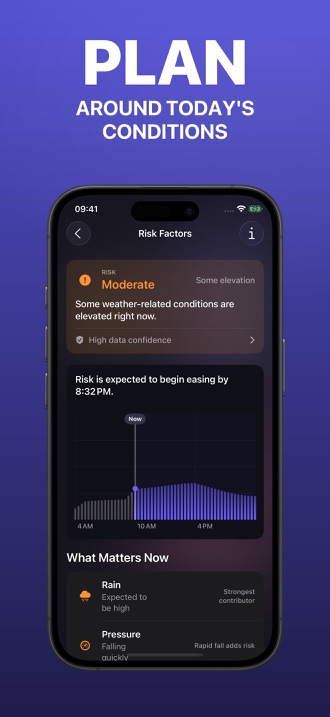
In the upcoming Auralog 27 release, the customizable Risk Engine brings together local weather and recent sleep in Risk Outlook. Use your location or choose a city, check conditions on iPhone or Apple Watch, and compare the context with your recorded history. Risk Outlook is not a clinical prediction and does not determine whether a migraine will occur.
Preview Auralog Risk OutlookHow to review a possible weather pattern
- Choose a review period long enough to include several attacks and different weather conditions.
- Compare similar conditions on both migraine and non-migraine days.
- Look for combinations—such as falling pressure plus poor sleep—rather than one reading alone.
- Keep logging entries that contradict the suspected pattern.
- Share the timeline with a clinician before making a health or treatment decision.
A repeated association may help you plan practical questions or reduce uncertainty. It still does not show that pressure caused the attack, and it cannot tell you what treatment is appropriate.
When weather tracking is most useful
Consider focused weather tracking if you already notice attacks around storms or seasonal changes, if you have moved or traveled, or if your clinician asked you to compare attacks with environmental conditions. If weather logging makes you anxious or encourages constant checking, scale back to automatic context and review it less often.
Sources and further reading
- Mayo Clinic: Are migraines triggered by weather changes?
- Farah et al.: Systematic review of barometric pressure changes and migraine
- Mayo Clinic: Migraine symptoms and causes
Sources were checked August 9, 2026. See our editorial policy for how Auralog guides are written and updated.