What should a headache log show your neurologist?
Bring a summary of headache days, attack timing and duration, typical and worst severity, associated symptoms, medicines or remedies and when you used them, treatment response, and how attacks affected normal activities. Keep the underlying entries available for follow-up questions.
A contemporaneous log reduces how much a visit depends on recall. The National Headache Foundation notes that tracking can help people communicate clear information to a healthcare provider and evaluate treatments over time. The goal is not to arrive with your own diagnosis; it is to give the clinician a more reliable timeline.
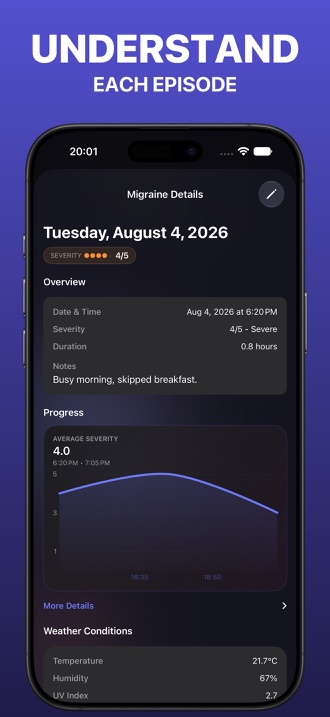
Build a one-page appointment summary
Headache and migraine days
Count the days on which you experienced headache or migraine symptoms during the review period. If an episode crossed midnight, keep your counting method consistent and tell your clinician how you handled it.
Frequency trend
Show whether the number of headache days appears stable, increasing, or decreasing. A monthly view or calendar can make clusters easier to see than a long chronological list.
Duration and severity
Summarize the usual range rather than only the worst event. If severity shifted during an attack, include checkpoints that show the sequence.
Symptoms and change from baseline
List recurring symptoms and highlight anything new or meaningfully different. New neurological symptoms or a sudden, severe headache may require prompt medical attention rather than waiting for a routine visit. Mayo Clinic lists headache symptoms that warrant emergency or prompt evaluation.
Treatments and response
Record what you used, when you used it, whether it helped, how quickly you noticed a change, and any relevant side effects. Bring an accurate medication list, including doses if your clinician has asked for them.
Functional impact
Note missed work or school, disrupted sleep, canceled activities, difficulty caring for others, or inability to perform normal tasks. This gives the care team context beyond a severity score.
Auralog keeps episode timing, severity changes, symptoms, possible triggers, treatments, and notes together. Review the calendar and create a report you can share with your healthcare provider. Auralog 27 also adds search to Migraine History. Review the report yourself before the appointment so you know what it contains.
Build your history with AuralogQuestions to take with the data
- Has my headache frequency changed enough to matter clinically?
- Which symptoms or changes should prompt urgent evaluation?
- Is my current treatment timing useful, and what should I record next?
- Which suspected patterns are worth testing—and which are likely noise?
- How long should I continue this level of tracking?
Write your top two or three questions before the visit. A large export is easier to use when it supports a short, prioritized conversation.
What not to do before the appointment
Do not edit away entries that contradict your theory. Do not stop or change prescribed medicines solely because of an app pattern. Avoid presenting risk scores or possible-trigger associations as medical conclusions. Bring the raw history, explain how you recorded it, and let the clinician interpret it in context.
A tracking app is not an emergency tool. Sudden severe headache, new weakness, speech difficulty, confusion, fainting, fever with stiff neck, or other alarming symptoms need appropriate professional evaluation.
Sources and further reading
- National Headache Foundation: Tracking Diaries
- Harvard Health Publishing: Keeping a headache diary
- Mayo Clinic: When to see a doctor for a headache
Sources were checked August 9, 2026. See our editorial policy for how Auralog guides are written and updated.